Solar Plant Dashboard: The Complete Guide to Real-Time Energy Monitoring & Performance Analytics
Modern solar power plants generate massive volumes of operational data every second. A powerful solar plant dashboard transforms this raw data into real-time intelligence that helps operators improve efficiency, reduce downtime, and maximize energy output.
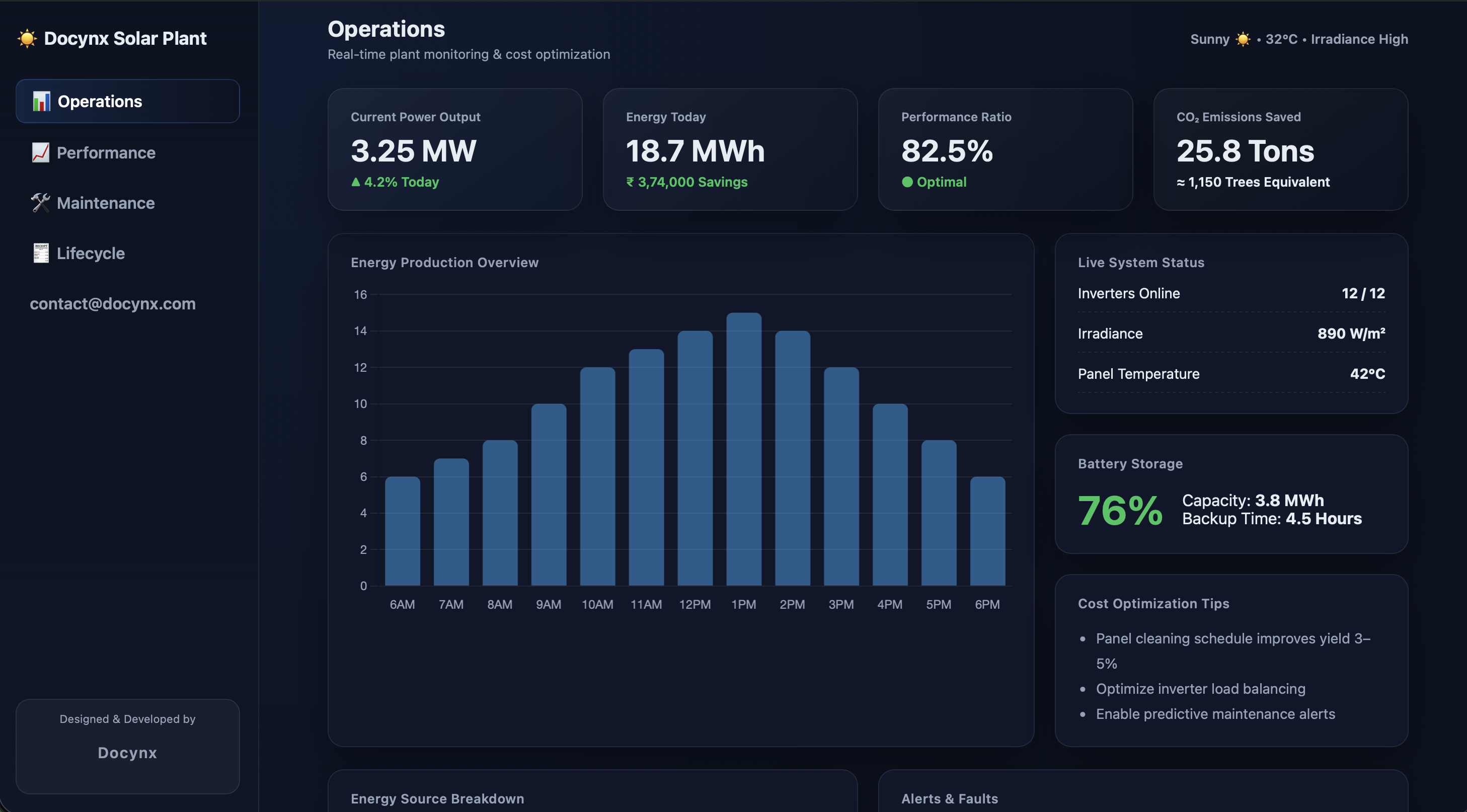
Explore the Interactive Solar Dashboard
Experience real-time solar plant intelligence with interactive analytics and performance insights.
As solar energy adoption accelerates worldwide, plant owners and energy companies need advanced monitoring tools to stay competitive. A solar plant dashboard acts as a centralized control center where operators can track performance metrics, detect faults, analyze trends, and optimize operations.
This guide explains how a modern solar energy monitoring dashboard works, what features matter most, and how interactive analytics help improve generation efficiency, reduce maintenance costs, and maximize return on investment.
What is a Solar Plant Dashboard?
A solar plant dashboard is a real-time monitoring and analytics platform that provides a centralized view of an entire photovoltaic power plant’s performance. It collects live data from solar panels, inverters, combiner boxes, weather stations, battery storage systems, IoT sensors, and grid interconnections, transforming complex technical signals into clear visual insights.
This intelligent interface bridges operational technology (OT) and business intelligence (BI), enabling plant operators, engineers, and energy managers to track generation efficiency, equipment status, and system reliability from a single control center. Instead of navigating multiple software tools or manually compiling reports, users can instantly understand how every asset in the plant is performing.
Modern solar dashboards display critical metrics such as real-time power output, daily and monthly energy generation, performance ratio (PR), plant load factor (PLF), inverter efficiency, battery charge cycles, and grid export levels. Advanced systems also integrate weather intelligence, irradiance tracking, and temperature analytics to explain performance fluctuations and forecast generation trends.
Beyond operations, a solar monitoring dashboard delivers financial and sustainability insights. Decision-makers can track revenue generation, tariff optimization, operational expenditure, maintenance costs, and return on investment. Environmental impact metrics such as carbon emissions avoided and fossil fuel displacement help organizations measure sustainability goals and ESG performance.
By replacing spreadsheets and disconnected reporting systems, a solar plant dashboard becomes the digital command center of energy operations — improving uptime, enabling predictive maintenance, optimizing asset lifecycle planning, and maximizing clean energy output.
Why Real-Time Solar Monitoring is Essential
Solar power generation is highly dynamic and influenced by constantly changing environmental conditions, equipment efficiency, and overall system reliability. Factors such as cloud cover, temperature variation, dust accumulation, shading, inverter performance, and grid stability directly impact energy output. Even small inefficiencies — if left unnoticed — can compound into substantial generation losses and revenue leakage over months and years.
Real-time solar monitoring enables plant operators to detect issues the moment they occur. Instead of discovering performance gaps through end-of-day reports or monthly summaries, teams receive live operational visibility. This immediate awareness allows faster troubleshooting, reduced downtime, and quicker restoration of optimal generation capacity.
Instant alerts and live dashboards help identify inverter faults, string underperformance, abnormal temperature spikes, voltage fluctuations, and communication failures. With actionable insights delivered in real time, maintenance teams can prioritize critical issues, schedule field inspections efficiently, and prevent minor anomalies from escalating into major equipment failures.
Beyond operational reliability, real-time monitoring also improves financial performance. Continuous tracking of generation trends, peak production windows, battery dispatch timing, and tariff-based export strategies ensures maximum revenue capture. Operators can optimize energy sales during high-price periods and reduce dependency on grid imports when storage is available.
Real-time visibility also supports predictive maintenance and long-term asset planning. Performance patterns, degradation trends, and anomaly detection models help forecast failures before they occur, extending equipment lifespan and lowering lifecycle costs.
In modern utility-scale and commercial solar plants, real-time monitoring is no longer optional — it is the foundation of efficient operations, smarter energy management, and sustainable profitability.
Key Benefits
- Immediate detection of performance drops: Real-time analytics instantly flag underperforming panels, inverter inefficiencies, shading losses, and abnormal generation patterns, allowing operators to act before minor issues escalate.
- Faster fault diagnosis and resolution: Live alerts and system-level visibility help maintenance teams pinpoint the exact source of failures — whether electrical, thermal, communication, or grid-related — reducing troubleshooting time significantly.
- Higher energy yield and plant efficiency: Continuous monitoring of irradiance, temperature, inverter loading, and panel performance ensures the plant consistently operates at optimal capacity, maximizing clean energy production.
- Reduced downtime and maintenance costs: Predictive maintenance insights minimize unexpected equipment failures, lower repair expenses, and reduce costly production interruptions.
- Accurate forecasting and operational planning: Historical generation data, weather intelligence, and performance trends enable reliable energy forecasting, workforce planning, and grid export scheduling.
- Better sustainability and ESG reporting: Automated tracking of carbon emissions avoided, fossil fuel displacement, and renewable contribution supports regulatory compliance and corporate sustainability goals.
Core Features of a Solar Power Plant Dashboard
1. Live Power Output Monitoring
A solar dashboard provides second-by-second visibility into real-time power generation across the entire facility. Operators can track megawatt output at plant, inverter, and string levels while monitoring hourly production curves. Expected vs actual generation comparisons help quickly detect performance deviations and energy losses.
2. Energy Generation Analytics
Interactive visualizations display daily, monthly, and annual energy production trends through intuitive charts and heatmaps. Historical performance analysis helps identify seasonal patterns, irradiation impact, equipment degradation, and production anomalies, enabling data-driven operational decisions.
3. Performance Ratio Tracking
Performance Ratio (PR) is a critical efficiency metric that measures actual plant output against theoretical potential. Dashboards continuously compute PR using irradiance and temperature-adjusted benchmarks, allowing operators to assess system effectiveness and benchmark performance across multiple sites.
4. Battery Storage Intelligence
Integrated battery analytics provide full visibility into energy storage operations. Operators can monitor state of charge (SoC), depth of discharge (DoD), cycle health, backup duration, and round-trip efficiency. Smart dispatch insights highlight optimal charge and discharge windows to maximize savings during peak tariff periods.
5. Asset Health Monitoring
Comprehensive equipment monitoring tracks inverter efficiency, panel temperature, string current, transformer condition, breaker status, and grid interface reliability. Asset health scoring and degradation indicators help prioritize maintenance and extend equipment lifespan.
6. Fault Detection & Intelligent Alerts
Automated alert systems detect overheating, voltage irregularities, communication failures, shading losses, inverter trips, and underperforming strings in real time. Severity-based notifications ensure maintenance teams respond faster to critical issues and minimize generation downtime.
7. Cost Optimization & Financial Insights
Advanced financial analytics convert technical performance data into business metrics such as revenue generation, tariff optimization, operational expenditure, maintenance costs, and return on investment (ROI). Decision-makers gain clarity on profitability and long-term asset planning.
How Solar Dashboards Improve Operational Efficiency
An interactive solar dashboard transforms complex operational datasets into clear, actionable intelligence. Instead of manually analyzing spreadsheets or fragmented monitoring tools, operators get a unified visual command center that highlights exactly where attention is needed. Underperforming panel strings, inverter load imbalances, grid export constraints, and environmental efficiency losses become instantly visible.
Granular system-level monitoring allows teams to drill down from plant-wide performance to individual assets within seconds. Operators can isolate faults, compare equipment performance, and benchmark generation across multiple sites — enabling faster, data-driven operational decisions.
Advanced analytics engines continuously process real-time telemetry, weather inputs, and historical performance records to uncover hidden inefficiencies. Pattern recognition identifies recurring issues such as thermal stress, shading impact, voltage instability, or equipment degradation that might otherwise go unnoticed.
Predictive analytics further enhance operational efficiency by forecasting potential failures before they occur. Machine learning models detect early warning signals in inverter behavior, battery performance, and panel output trends. This allows maintenance teams to shift from reactive repairs to proactive service scheduling.
Proactive maintenance reduces emergency breakdowns, minimizes generation downtime, extends asset lifespan, and lowers operational expenditure. With optimized maintenance cycles and smarter resource planning, plants achieve higher uptime and more consistent energy output.
By combining real-time monitoring, intelligent diagnostics, and predictive maintenance capabilities, solar dashboards become essential tools for maximizing operational efficiency and long-term plant performance.
Advanced Analytics & AI Insights
Modern solar analytics platforms leverage artificial intelligence and machine learning to transform raw telemetry into intelligent operational strategies. By continuously processing high-frequency sensor data, weather feeds, and historical performance records, AI systems uncover hidden inefficiencies and optimization opportunities across the entire solar ecosystem.
Instead of reactive monitoring, operators gain predictive and prescriptive intelligence that improves energy yield, asset reliability, and long-term plant profitability.
- Soiling Loss Detection — AI models analyze irradiance vs output patterns to detect panel dirt accumulation and recommend optimal cleaning schedules.
- Thermal & Heat Loss Analysis — Intelligent thermal profiling identifies hotspots, inverter overheating, and temperature-driven efficiency degradation.
- Weather-Based Generation Forecasting — Machine learning models combine satellite weather data with historical trends to predict short-term and seasonal power generation.
- Battery Cycle Optimization — Smart algorithms optimize charge/discharge cycles to extend battery lifespan and maximize peak-tariff revenue windows.
- Energy Curtailment Risk Alerts — Predictive systems warn operators about potential grid export limits and curtailment risks before losses occur.
- Anomaly & Fault Pattern Recognition — AI detects abnormal performance signatures across inverters, panels, and transformers for early fault prevention.
- Performance Degradation Modeling — Long-term analytics estimate equipment aging and efficiency decline for smarter asset replacement planning.
AI-driven recommendations guide operators with precise, data-backed actions — from cleaning schedules and load balancing to maintenance planning and storage dispatch strategies.
By combining real-time analytics, predictive intelligence, and automated optimization, advanced solar dashboards evolve from monitoring tools into autonomous performance management systems.
Maintenance & Asset Lifecycle Management
Solar power plants are long-term infrastructure assets designed to operate efficiently for 20–30 years. Over time, equipment performance gradually degrades due to environmental stress, electrical wear, and mechanical fatigue. Lifecycle management dashboards provide centralized visibility into asset condition, reliability trends, and replacement planning across the entire facility.
Instead of relying on manual logs and scattered maintenance records, operators gain a unified intelligence layer that connects operational data with maintenance workflows and financial planning.
- Preventive Maintenance Scheduling — Automated service calendars based on runtime hours, performance thresholds, and manufacturer recommendations.
- Work Order Tracking — End-to-end visibility into maintenance requests, technician assignments, service status, and completion timelines.
- Asset Health Scoring — Real-time reliability ratings for inverters, panels, transformers, batteries, and balance-of-system components.
- Failure Trend Analysis — Historical fault pattern analysis to identify recurring issues and high-risk equipment clusters.
- Spare Parts & Inventory Planning — Usage forecasting ensures critical components are available before failures occur.
- Warranty & Service Contract Monitoring — Track coverage periods, vendor SLAs, and compliance with maintenance agreements.
- CapEx Forecasting — Data-driven capital expenditure projections for refurbishments, retrofits, and asset replacement cycles.
Lifecycle intelligence reduces unplanned downtime, extends equipment lifespan, and enables financially optimized maintenance strategies. By integrating operational metrics with asset management systems, solar dashboards evolve into complete infrastructure governance platforms.
Financial & Sustainability Impact
Modern solar intelligence dashboards extend beyond engineering analytics by translating operational performance into measurable financial and sustainability outcomes. They provide executives, investors, and energy managers with a clear view of how renewable infrastructure contributes to profitability, cost efficiency, and environmental responsibility.
By integrating production data with financial models and ESG reporting frameworks, organizations can make informed strategic decisions backed by real-time evidence.
- Revenue Tracking — Real-time conversion of energy generation into revenue based on tariffs, power purchase agreements (PPAs), and market pricing.
- Operational Cost Control — Monitor maintenance expenses, asset utilization efficiency, downtime impact, and cost-per-megawatt metrics.
- Return on Investment Monitoring — Track payback periods, internal rate of return (IRR), net present value (NPV), and long-term profitability forecasts.
- Carbon Emission Savings — Automated calculation of CO₂ reduction compared to fossil fuel baselines using standardized emission factors.
- Sustainability & ESG Metrics — Environmental impact dashboards support ESG disclosures, sustainability reporting, and regulatory compliance.
- Energy Independence Indicators — Measure grid reliance reduction and renewable energy contribution to total consumption.
- Incentives & Subsidy Optimization — Track renewable energy credits, tax incentives, and policy-linked financial benefits.
These insights help organizations align clean energy initiatives with financial performance, investor expectations, and global sustainability commitments.
Who Uses Solar Plant Dashboards?
Solar plant dashboards are used by a wide range of stakeholders involved in renewable energy operations, asset management, and investment decision-making. These platforms transform complex technical data into actionable intelligence tailored to different user roles.
- Solar Farm Operators — Monitor real-time generation, equipment health, and site performance to ensure maximum plant efficiency.
- Independent Power Producers (IPPs) — Track multi-site production, contractual energy delivery, and revenue performance across portfolios.
- Energy Utility Companies — Manage grid integration, demand balancing, and renewable contribution to national energy supply.
- Commercial & Industrial Rooftop Operators — Optimize on-site solar usage, reduce electricity bills, and track sustainability goals.
- Renewable Energy Consultants — Analyze performance data to advise clients on optimization strategies and infrastructure planning.
- Infrastructure Investors & Asset Managers — Monitor ROI, asset reliability, and long-term financial performance of energy portfolios.
- Operations & Maintenance (O&M) Teams — Identify faults, schedule preventive maintenance, and reduce system downtime.
- Sustainability & ESG Officers — Track carbon reduction metrics and ensure compliance with environmental reporting standards.
By serving technical teams, business leaders, and investors alike, solar dashboards become a unified intelligence layer connecting operations, finance, and sustainability management.
Why Interactive BI Dashboards Are Better Than Static Reports
Traditional reports are static snapshots that quickly become outdated in fast-moving operational environments. They require manual compilation, lack flexibility, and often fail to deliver insights when decisions need to be made. Interactive Business Intelligence (BI) dashboards transform reporting into a dynamic, real-time decision support system.
By combining live data pipelines with visual analytics, dashboards empower users to explore performance from high-level summaries down to granular operational details — all within seconds.
- Live Data Refresh — Automatically updated metrics ensure decisions are based on the latest operational data.
- Drill-Down Analytics — Users can move from summary KPIs to plant-level, inverter-level, or component-level insights instantly.
- Visual Trend Analysis — Interactive charts and heatmaps reveal patterns, seasonality, and anomalies more clearly than spreadsheets.
- Instant KPI Visibility — Critical performance indicators are highlighted in real time for faster executive decisions.
- Cross-Device Accessibility — Access dashboards securely from desktops, tablets, control rooms, and mobile devices.
- Self-Service Exploration — Non-technical users can filter, segment, and analyze data without depending on analysts.
- Automated Alerts & Thresholds — Smart notifications flag deviations before they impact performance or revenue.
Interactive BI dashboards shift organizations from reactive reporting to proactive performance management, enabling faster decisions, better collaboration, and measurable operational improvements.
Future of Solar Energy Analytics
As renewable infrastructure expands, data intelligence will become the backbone of energy management. Smart grids, IoT sensors, and AI-powered analytics will redefine how solar plants operate.
Advanced dashboards will enable autonomous optimization, predictive reliability, and fully digital energy operations.
Explore the Interactive Solar Dashboard
Experience real-time solar plant intelligence with interactive analytics and performance insights.
Frequently Asked Questions
What is a Solar Plant Operations Dashboard?
A Solar Plant Operations Dashboard is a real-time monitoring and analytics system that provides a complete overview of solar power plant performance. It tracks electricity generation, inverter output, battery storage levels, equipment status, maintenance alerts, and sustainability metrics in a single interactive interface.
How does a solar monitoring dashboard improve plant efficiency?
The dashboard helps plant operators identify performance losses, detect equipment faults early, and optimize energy production. By analyzing generation trends, inverter load balancing, and weather impact, teams can increase uptime, maximize yield, and reduce operational costs.
What KPIs are tracked in a solar analytics dashboard?
Key performance indicators include real-time power output, daily energy generation, performance ratio, plant load factor, battery charge levels, equipment uptime, maintenance costs, revenue analytics, and carbon emissions saved.
Can this dashboard integrate with SCADA and IoT systems?
Yes. The dashboard integrates seamlessly with SCADA systems, IoT sensors, weather data services, ERP platforms, and maintenance management software to deliver live operational and financial insights.
Who should use a solar plant performance dashboard?
Solar plant owners, operations managers, maintenance engineers, energy analysts, sustainability leaders, and financial planners use this dashboard to monitor plant health and optimize lifecycle decisions.
Does the dashboard support predictive maintenance?
Yes. AI-driven analytics detect anomalies, monitor asset health, and forecast potential failures. This enables predictive maintenance planning, reduces downtime, and extends equipment lifespan.
How does a solar dashboard help reduce operational costs?
It reduces costs by identifying inefficiencies, optimizing battery usage, improving maintenance scheduling, preventing equipment failures, and maximizing generation during peak tariff periods.
Is this dashboard suitable for utility-scale solar plants?
Absolutely. The platform is built for utility-scale and commercial solar plants with scalable analytics, multi-site monitoring, asset lifecycle tracking, and financial performance reporting.